Priyankush Ghosh

Priyankush Ghosh

Ph.D. Scholar

School of Earth and Planetary Sciences (SEPS)

National Institute of Science Education and Research (NISER), India

I am currently specializing in photochemical kinetics modeling of exoplanetary atmospheres, including hot-Jupiters, super-Earths, and solar system terrestrial analogs such as Venus and Earth.

Research Overview

The launch of the James Webb Space Telescope (JWST) has opened a new frontier era for detailed atmospheric characterization of both solar-system and extrasolar planetary atmospheres. My research focuses on understanding the chemical composition of these atmospheres by studying detailed equilibrium and disequilibrium processes (such as photochemistry and vertical mixing) through modeling. I also work on coupling photochemical kinetics with radiative transfer and interior-atmosphere exchange models to interpret current and upcoming observations from JWST and future missions like HWO and LIFE, and I am particularly interested in closely complementing my modeling work with observational data.

The XODIAC Model

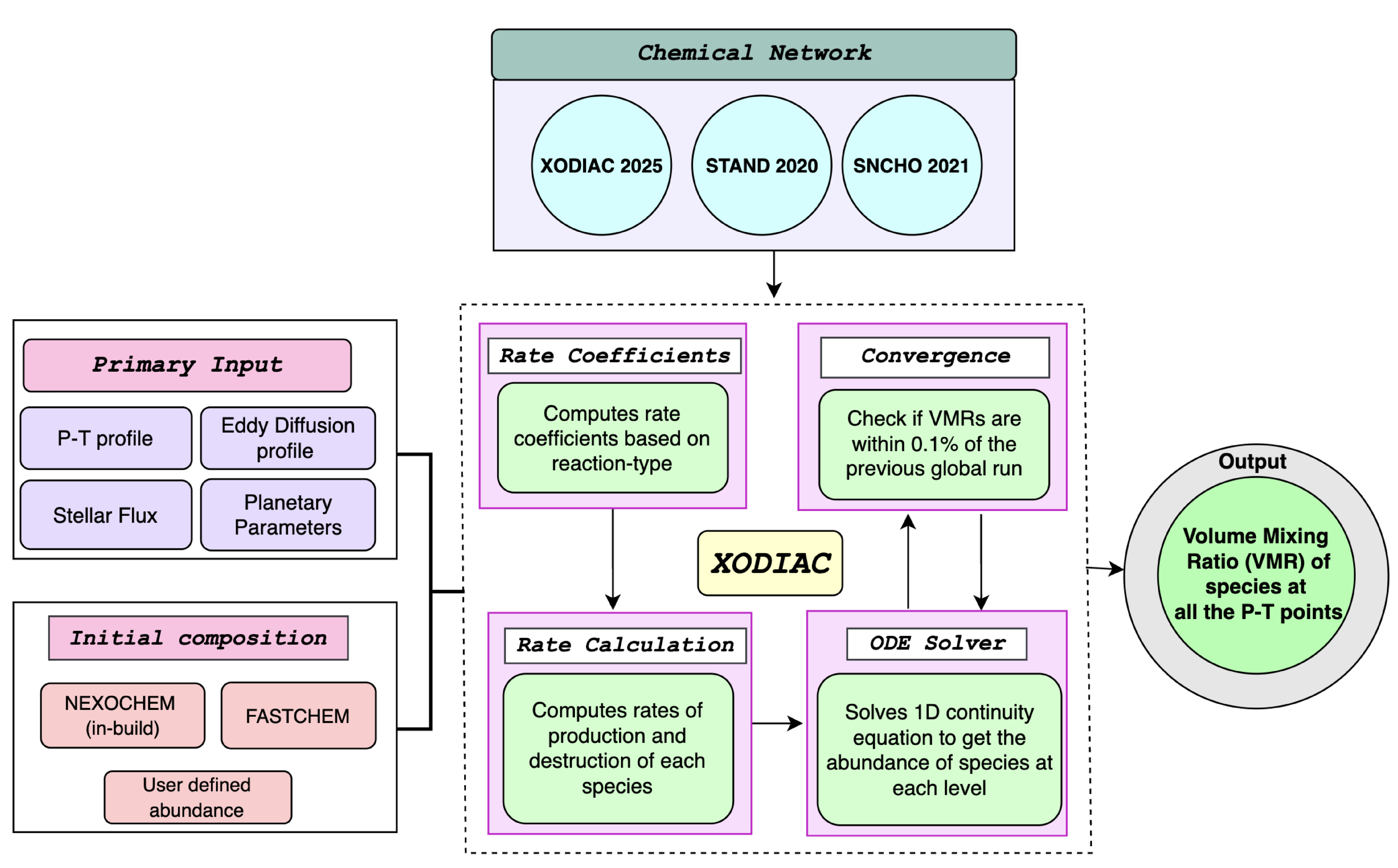
I led the development of XODIAC (eXOplanetary model for equilibrium and DIsequilibrium Atmospheric Chemistry), a fully Python-based fast, parallelized, as well as GPU-accelerated photochemical kinetics model. It includes built-in equilibrium chemistry models: NEXOCHEM and FastChem, and multiple chemical reaction networks for exoplanetary atmospheres, including the largest state-of-the-art chemical network, XODIAC-2025, linking 594 C/H/O/N/P/S/Metals-based species connected through 7720 reactions. The model is closely benchmarked with the Eulerian code VULCAN and the Lagrangian code ARGO in HD189733 b, and it can simulate the effects of both the codes with much lesser runtime.

Publications

Research Highlights

XODIAC Model Benchmarking

Photochemical Kinetics with XODIAC

XODIAC is a high-performance (both CPU and GPU-accelerated) 1D photochemical kinetics model designed to simulate the complex chemistry of diverse planetary and exoplanetary atmospheres. Our paper (Ghosh et al. 2026a) showcases its capabilities and flexibilities. In this paper, we compile a new thermochemical database, describe the detailed atmospheric chemistry of the well-studied hot-Jupiter HD189733 b across three different chemical networks, including detailed phosphorus chemistry, and also trace key reaction pathways for converting one species to another.

Sulfur Chemistry in Exo-Venus Atmospheres

Comprehensive Sulfur Chemistry network for Venus and Exo-Venus Atmospheres using XODIAC

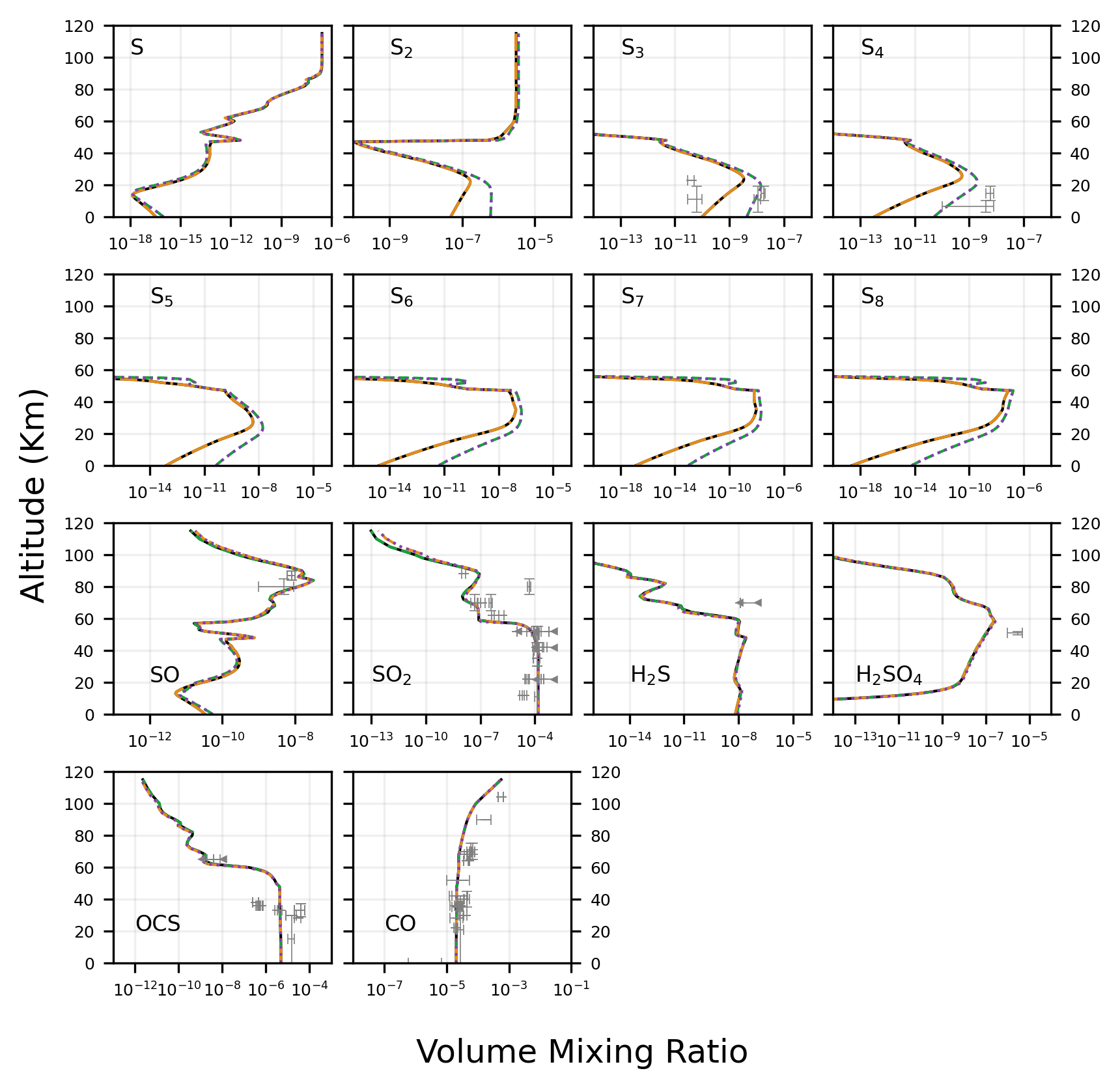
This study (Ghosh et al. 2026b; in press) introduces an expanded sulfur chemistry network that includes excited sulfur species S(¹D) and SO(¹Δ), validated against observations of Venus. We explore the implications of this chemistry on both Venus and Exo-Venus analogs. In this work, we compute the kinetic parameters for S+CO2 reactions using quantum chemical calculations and derive the NASA 7-term polynomial coefficients for the excited species. We also introduce a 1 ppm near-surface atomic sulfur source to constrain S3 and S4 observations of Venus and also apply this atomic sulfur source to Exo-Venus atmospheres.

More About Me

Before embarking on my Ph.D. journey at NISER (since 2021), I built my academic foundation in Physics with a focus on the cosmos. I completed my B.Sc. at the University of Burdwan (West Bengal, India) in Physics (Hons.) during 2014-2017 and subsequently moved to Tezpur Central University (Assam, India), where I earned my M.Sc. in Physics with a specialization in Astrophysics (2017-2019).

Beyond research, I am actively involved in studying and analyzing the Indian stock market, applying the same analytical rigor to my portfolio as I do to my atmospheric modeling studies. In my free time, I play competitive table tennis and engage in high-intensity e-sports, specifically titles like Call of Duty. I also enjoy playing ukulele for fun.